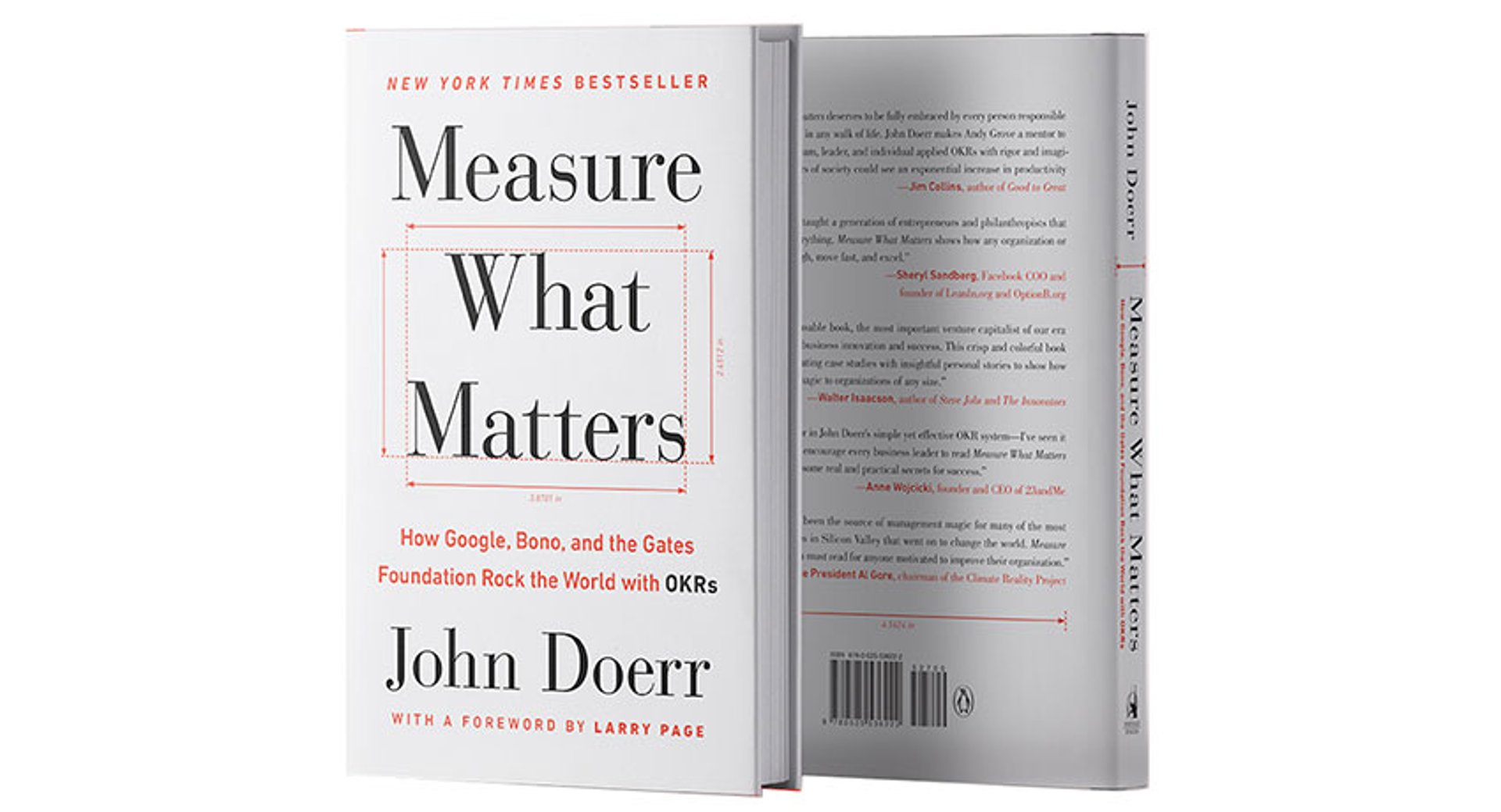

Summary - Learn how to implement OKRs in your organization using John Doerr's framework from 'Measure What Matters.' This five-step guide translates strategy into action and builds the systems teams need to stay aligned and responsive.
Implementing OKRs Using "Measure What Matters"
John Doerr's book Measure What Matters transformed how organizations think about performance management. By introducing Objectives and Key Results (OKRs), Doerr showed teams how to measure progress with precision and speed—exactly what today's fast-moving companies need.
But knowing what OKRs are and actually implementing them are two different things. The real challenge is translating your organizational strategy into OKRs that stick, cascade across teams, and drive meaningful results. This guide walks you through a proven five-step system to make OKRs work in your organization.
Why OKRs Matter: A Quick Foundation
OKRs aren't entirely new. They evolved from Peter Drucker's Management by Objectives (MBO), introduced in 1957, and built on the Balanced Scorecard framework developed by Kaplan and Norton in the late 1980s. What makes OKRs different is their focus on clarity, alignment, and real-time visibility—making "strategy everyone's everyday job."
Think of it this way: navigating with a paper map versus using Google Maps.
With a paper map (old management practices), you only check progress at major landmarks—like quarterly performance reviews. By the time you realize you're off track, you've already wasted time and resources getting back on course.
With Google Maps (OKR management), you get real-time updates on your location and immediate warnings when you deviate from your route. The system shows you alternate paths based on current conditions, and you adjust on the fly.
OKRs are the Google Maps of your business. They provide near real-time visibility into how your organization is progressing—down to the team and individual level. You can see which teams are performing well and which need support. Your people can see progress, adjust tactics, and improve continuously.
The result? Organizations using OKRs typically move faster, spend less, and achieve better outcomes than those relying on traditional planning cycles.
The Proven OKR System: Five Steps

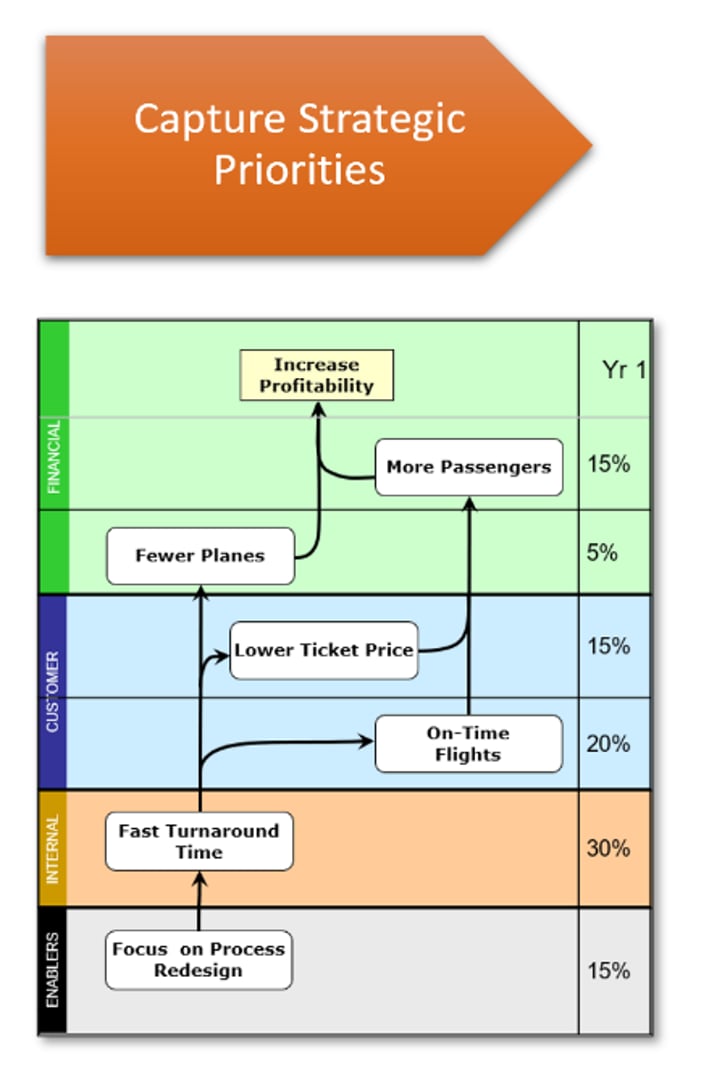
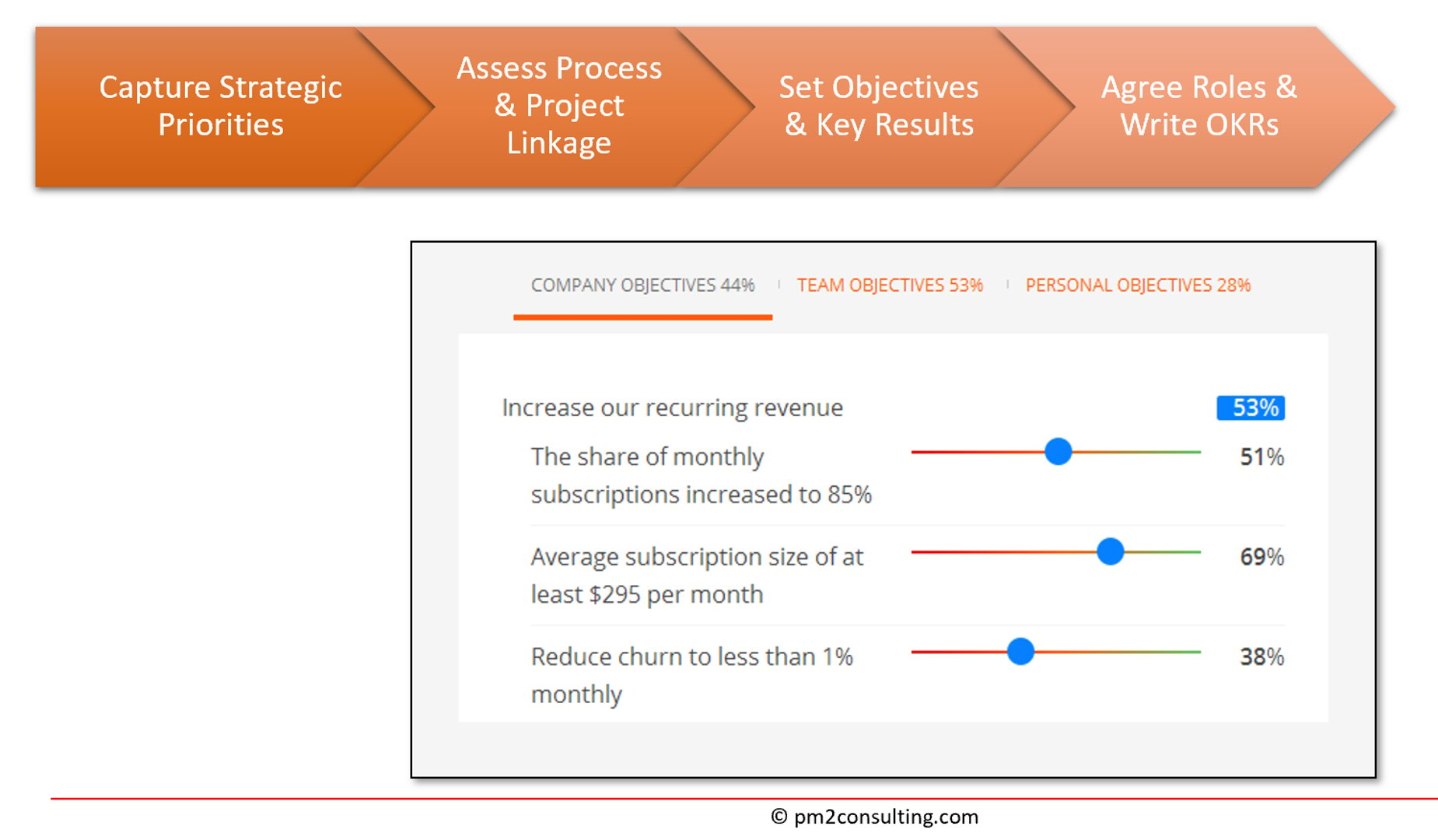
Step 1: Capture Strategic Priorities
Every organization has a strategy. Your job is to capture it clearly.
If you don't have a formal strategy document, don't worry. Your leadership team knows the direction—they just need help articulating it. A short conversation (what we call a "two cups of coffee" discussion) usually reveals what you need to know.
Simplify your strategy into 7–10 key Strategic Objectives. Use a Strategy Map to document and communicate the strategy story, but other tools work too.
Once your Strategic Objectives are solid, prioritize them ruthlessly. Harvard strategy professor Michael Porter said it best: "Strategy is more about what you stop doing." Leadership must set clear priorities and communicate them across the organization.
Step 2: Assess Process and Project Linkage
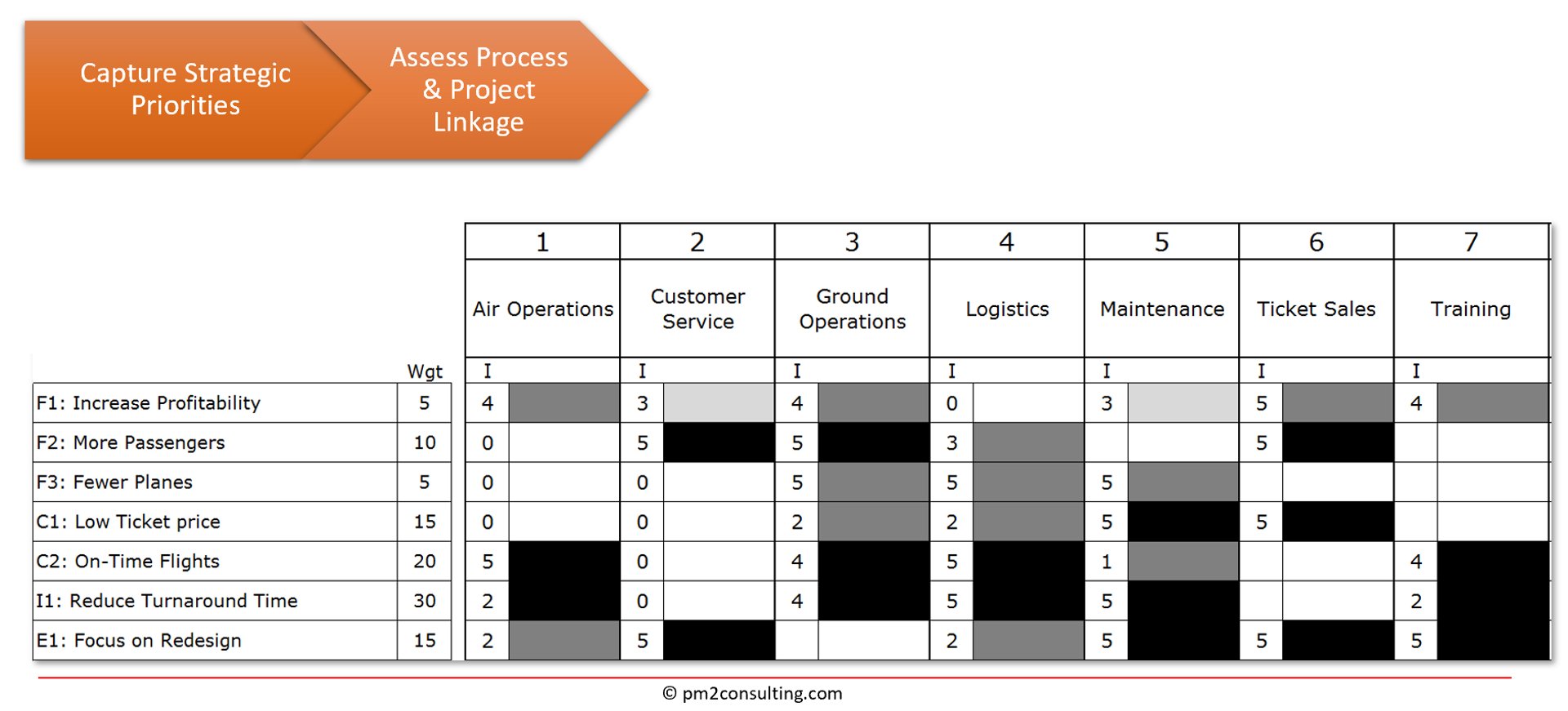
For your organization to achieve its strategy, every activity and project must support your Strategic Objectives.
Identify which processes and projects have the highest impact on your most important objectives. These become your critical performance nodes—the places where OKRs must be defined most clearly.
We call this approach your Strategic Ontology. It connects what you do every day to what matters most strategically.
Step 3: Set Objectives and Key Results
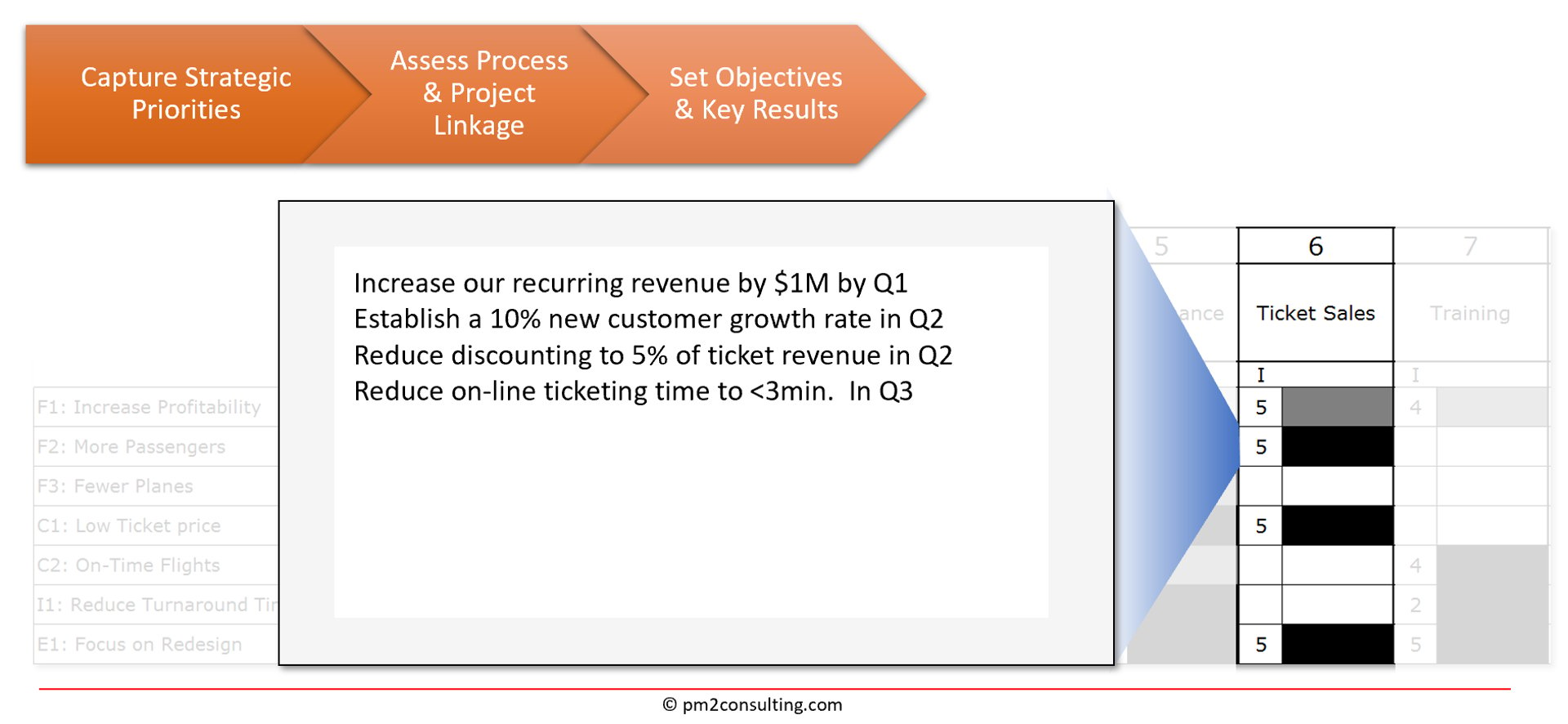
Now that you understand your strategy and critical performance nodes, it's time to write your OKRs.
The formula is straightforward: Objective + Key Results = OKR
An Objective is the qualitative goal you want to achieve (e.g., "Become the market leader in customer satisfaction"). Key Results are the measurable outcomes that prove you've achieved it (e.g., "Increase Net Promoter Score from 45 to 65" or "Reduce support ticket resolution time from 48 hours to 24 hours").
Most objectives require multiple Key Results. Aim for 3–5 Key Results per Objective to keep focus sharp.
Step 4: Agree on Roles and Write OKRs
Now comes the critical part: clarity on who does what.
Define roles and responsibilities so everyone understands their contribution to each OKR. Use frameworks like RACI (Responsibility Assignment Matrix) to map ownership clearly. This simple step cuts meeting time by roughly 25%, boosts productivity, and reduces conflict.
At this point, you've built the technical foundation of OKRs. Every department, team, and individual (depending on your depth) knows what they need to do, when they need to do it, and why it matters.
You've now completed about 20% of your OKR implementation. The remaining 80%—and the harder part—is building the social and cultural structure that makes OKRs drive performance.
Step 5: Build Reporting Cycles and Launch
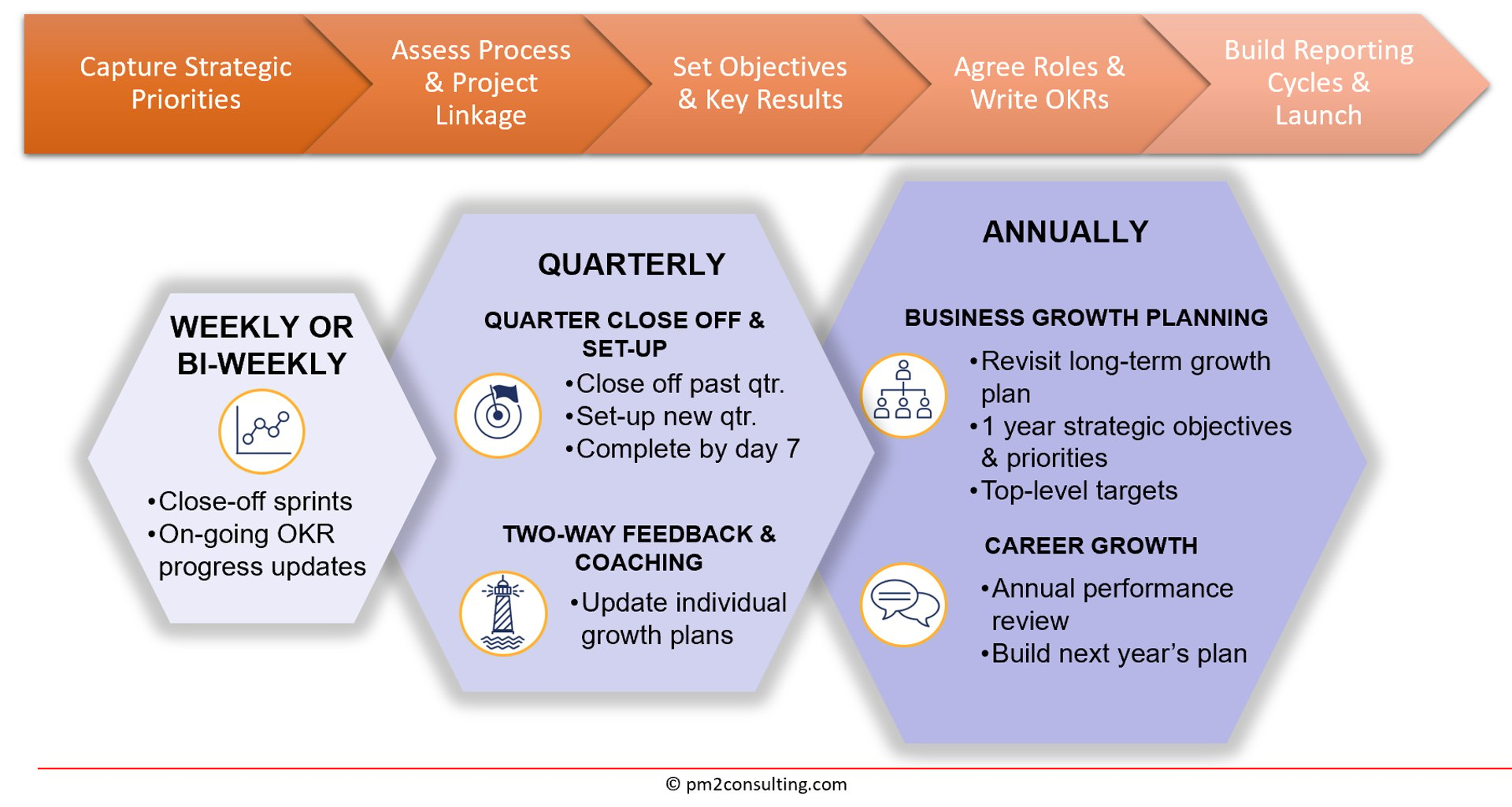
Create a safe, transparent environment where teams can visualize performance, celebrate wins, and address challenges together.
Think of how a sports team operates. Every member understands their role and everyone else's. There's complete visibility into performance stats. Coaches, managers, and support staff help teams see what's working and what needs adjustment. Feedback happens constantly—before, during, and after the game—and players welcome it.
Your organization needs the same dynamic. Regular check-ins (weekly or bi-weekly work sessions, monthly reviews) keep everyone aligned and responsive. People see progress in real time. Teams collaborate to fix problems fast.
Ready to Launch? Check Your Foundation
Before you launch, confirm you have these building blocks:
- Strategy clarity. Your leadership team can articulate the direction (documented or discussed).
- Priority-setting ability. Your team can identify what matters most and what to stop doing.
- Process understanding. You know how your work connects to strategic outcomes.
- Measurable results. You can identify the Key Results that prove success.
- Role clarity. People understand who owns what.
- Regular meetings. You hold periodic performance reviews and check-ins.
If you can check most of these boxes, you have everything you need. The rest is assembly and discipline.
Launching Your OKR Solution
It's time to stop planning and start doing. Implementing OKRs is like learning to ride a bike—you learn by doing it, adjusting as you go.
Based on experience, most organizations see serious results within three quarters. But you'll notice improvements within weeks: better focus, faster decisions, and stronger alignment.
The key is consistency. Stick with the process, review progress regularly, and refine as you learn.
For a deeper dive into dashboard design and OKR tracking, check out our guide to building a fundamental OKR dashboard.
About Pm2
Brett is an Executive Partner at Pm2 (Performance Measurement & Management), an international consulting firm specializing in strategic dashboards and scorecards. Their frameworks include OKRs, Balanced Scorecard, 4DX (Four Disciplines of Execution), Lean, and Six Sigma. Their work has been featured in Harvard Business Review, Fortune, and Forbes, as well as countless business books and publications. We're grateful to have Brett as a contributor to our blog.
Related Articles

The real-time strategy dashboard
By Brett Knowles — November 21st, 2024
Supercharge your KPIs with OKRs
By Mark Brownlee — January 26th, 2023
Implementing OKRs: The behavior change framework for faster, cheaper, easier adoption
By Brett Knowles — December 9th, 2019