

Summary - OKRs (Objectives and Key Results) are a goal-setting framework that aligns everyone in an organization around shared priorities. Learn how Klipfolio implemented OKRs across its product and engineering teams, what worked, what didn't, and the best practices that make the system stick for growing teams.
Klipfolio's product team adopted a performance management system based on objectives and key results (OKRs) in early 2018. Within months, the entire organization followed. Here's what we learned.
What are OKRs?
OKRs (Objectives and Key Results) are a goal-setting framework that aligns everyone in an organization around shared priorities, expressed as ambitious targets with measurable outcomes.
The system's strength lies in its simplicity. Objectives define where you're going. Key results tell you whether you got there. Ambitious objectives push teams beyond their comfort zone. Measurable key results make it clear, without ambiguity, whether the goal was reached.
We've written more about what they are and why they complement agile teams if you want to go deeper before reading on.
Why OKRs work for growing teams
OKRs solve a problem that gets worse as teams grow: everyone is busy, but not everyone is moving in the same direction. Without a shared framework, leaders end up pasting numbers into a spreadsheet or explaining context from scratch every time someone needs a decision made.
OKRs give everyone the same picture without requiring a meeting to create it.
Five advantages stand out:
Alignment: Every team member pulls toward the same priorities, not just their own backlog.
Focus: Work that doesn't contribute to an objective gets deprioritized, not just deferred.
Engagement: Teams with defined goals have a clearer sense of why their work matters.
Performance: Ambitious targets push teams to exceed what they'd set for themselves.
Autonomy: Teams know where they're going and can find their own path to get there.
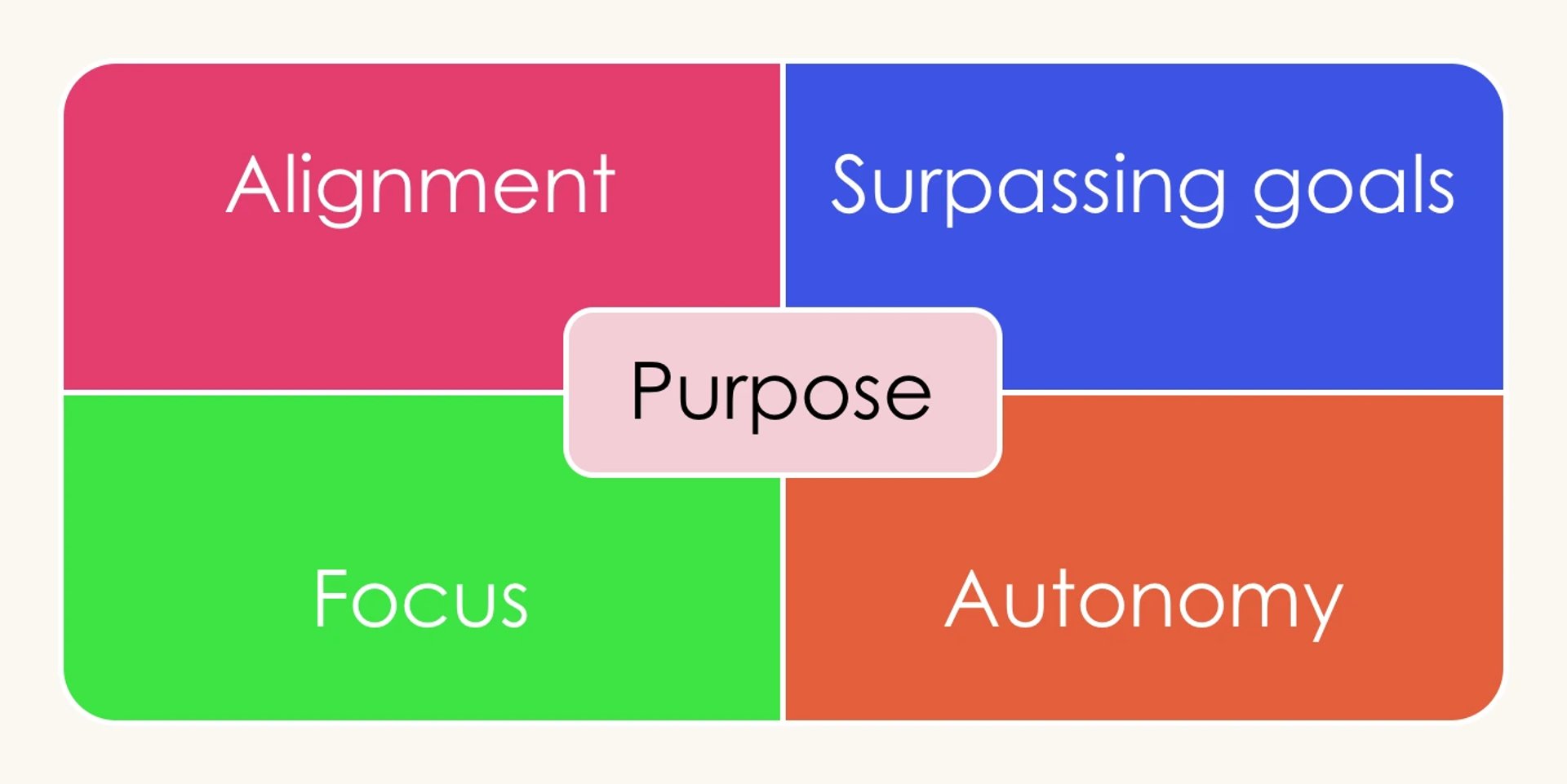
Alignment is the most critical of the five. It's also the hardest to maintain as headcount grows. OKRs create alignment without removing team autonomy, which is a combination most management frameworks can't deliver.
How we structured our OKRs
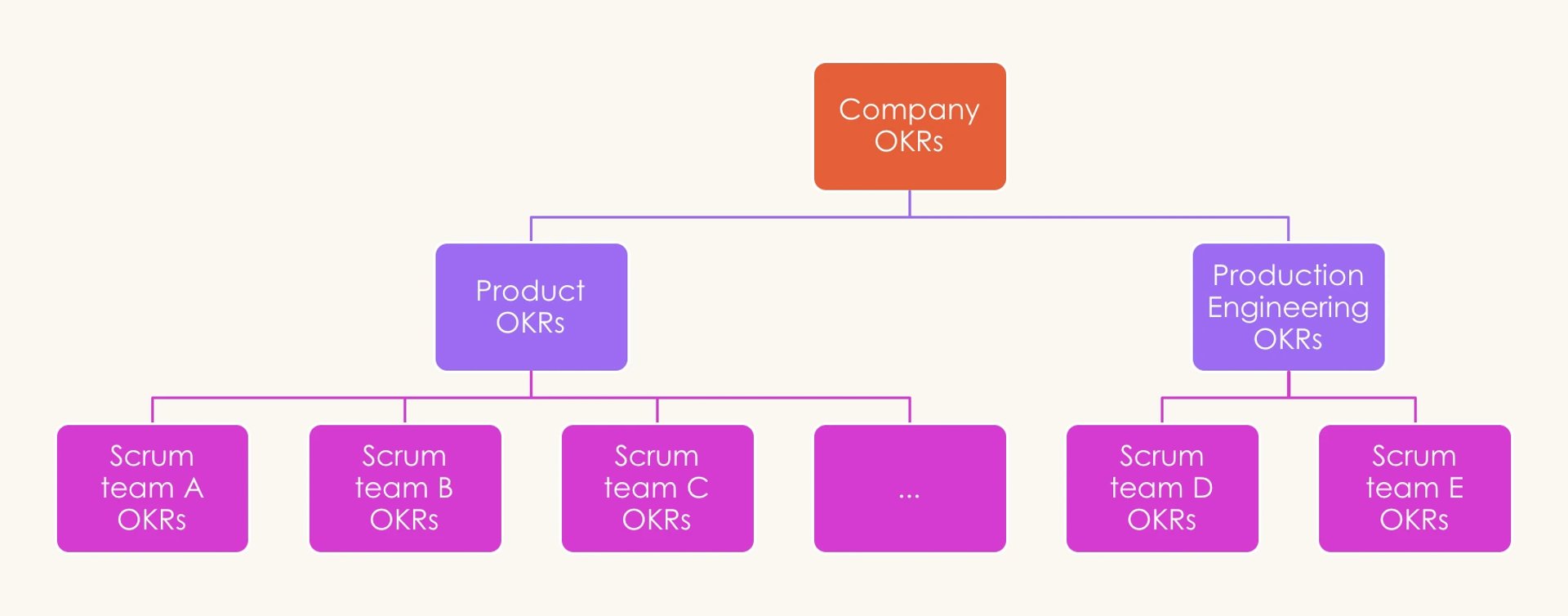
OKRs work at every level of an organization, but only if each level connects to the one above it. Here's how we set that up:
Company-level: Senior management creates a long-term planning document with objectives and measurable key results spanning three years.
Quarterly company-wide: We establish company-wide OKRs each quarter that define our next steps toward those longer-term goals.
Product team level: The product leadership team sets high-level product OKRs each quarter, reflecting how each team will contribute to the business OKRs.
Team level: Each agile team creates quarterly OKRs showing how they'll contribute to the high-level product OKRs.
This hierarchy makes interdependencies visible. Every team knows why their work matters and how it connects to the organization's direction. That clarity is hard to replicate with any other system.
Our quarterly process
A couple of weeks before each quarter begins, the product leadership team drafts high-level product OKRs. Teams then develop their own OKRs informed by those targets. Leadership and all scrum teams meet to review the team OKRs, refine them based on feedback, and surface cross-team dependencies.
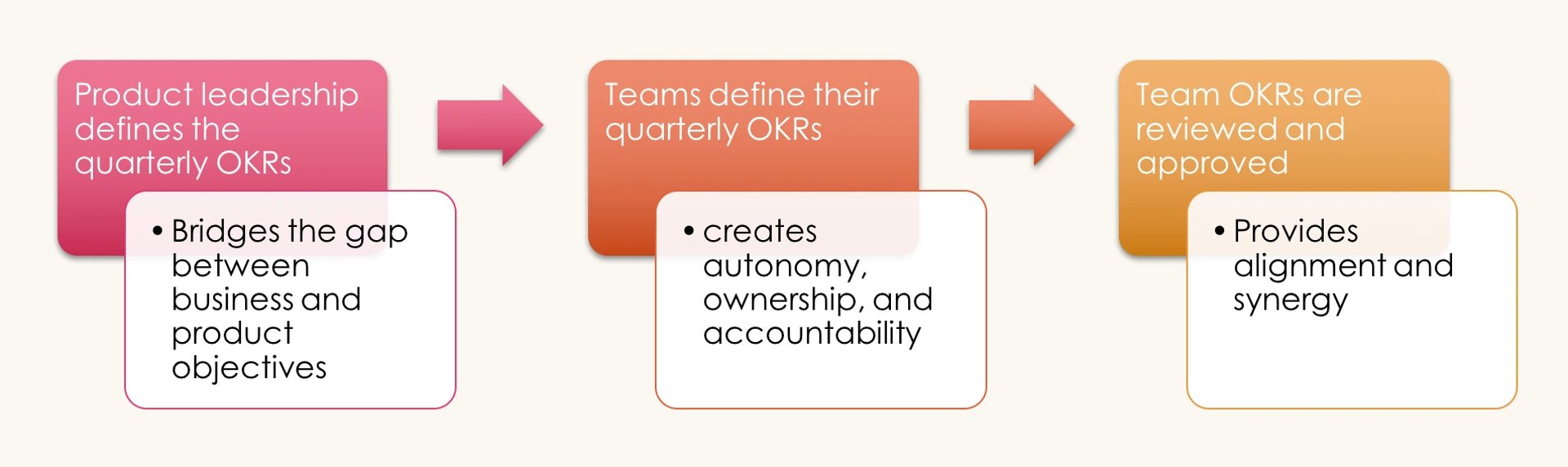
We've run this cycle every quarter since early 2018. The quality of both the process and the OKRs improves each time.
One thing we changed early: in our first cycle, teams had pre-defined backlogs and we reverse-engineered OKRs from those backlogs. That defeated the purpose. OKRs should give teams a goal and trust them to find the answers, not document decisions already made. In later cycles, teams brainstorm OKRs from scratch, using their understanding of what actually moves the needle.
We also run regular retrospectives with team leads to identify what's working and what to adjust.

What's worked well
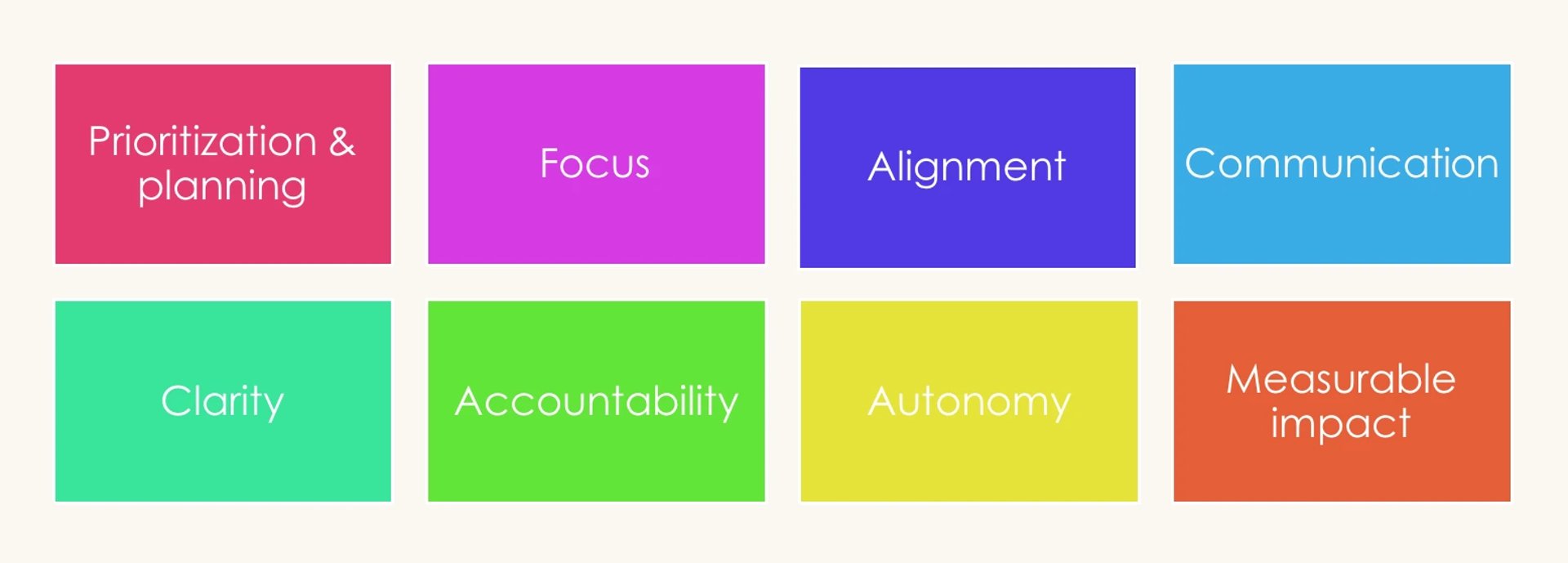
Since adopting OKRs, we've seen consistent gains across three areas.
Prioritization and focus
OKRs make sprint planning easier. If a work item doesn't contribute to a current OKR, it gets deprioritized. That single filter prevents scope creep, reduces noise, and keeps teams pointed at what matters. Leaders spend less time explaining what not to work on.
Alignment and communication
When teams participate in defining their own OKRs, they own them. That ownership makes cross-team communication clearer, makes it easier to explain why a team can't take on additional requests, and surfaces dependencies before they become blockers. Communication with the executive team improved significantly once OKRs gave everyone a shared reference point.
Measurement and accountability
A metrics-based approach removes ambiguity. Regular checkpoints make it easy to spot when a team is diverging from the plan, and clear goals make it easy to course-correct before the quarter ends. Leaders get reliable numbers they can act on, not estimates they have to question.
We also used our own product to monitor OKRs. We created a Klip for each team and a dashboard showing real-time progress against OKRs, so the numbers were always current and visible without anyone having to pull them manually.
Stumbling blocks we encountered
OKRs aren't automatic. We made mistakes, and they're worth naming so you don't repeat them.
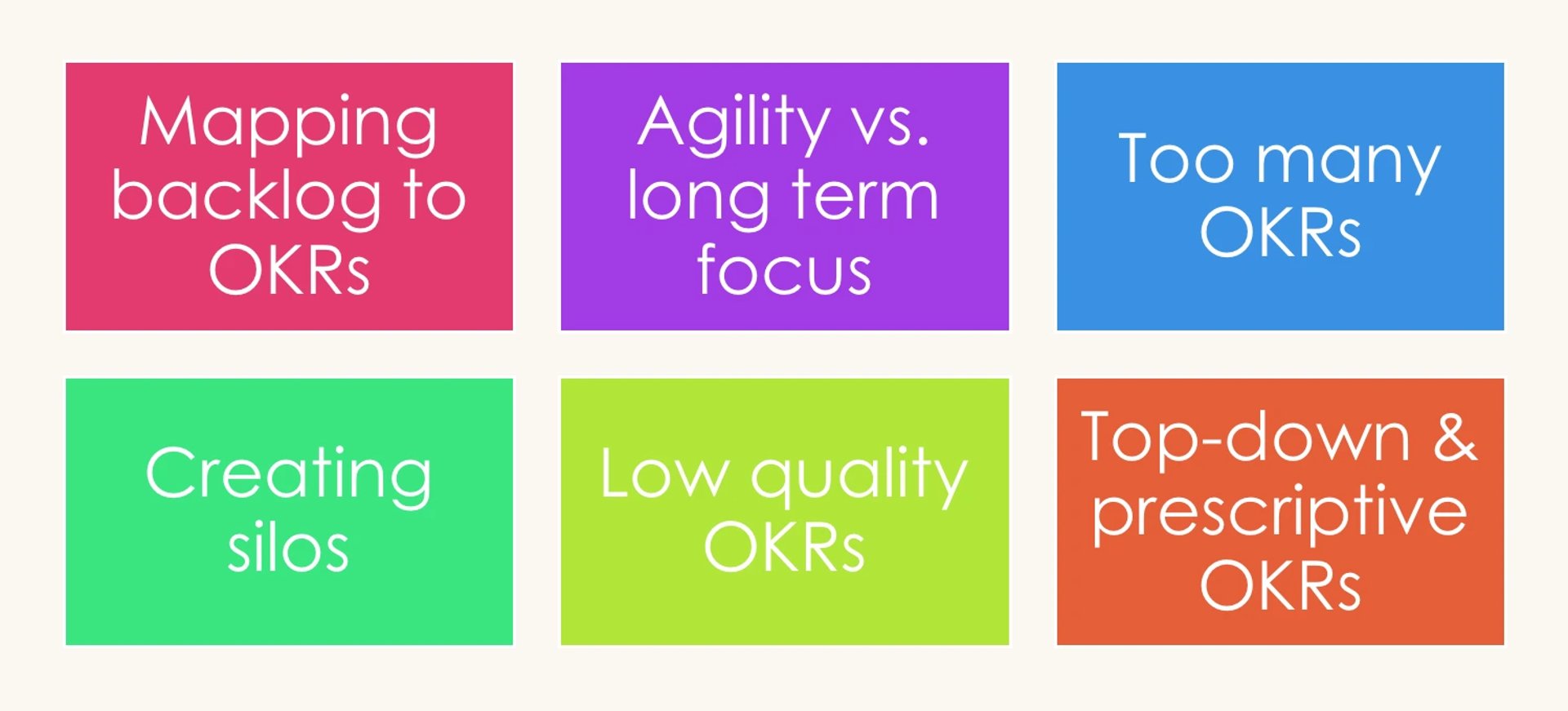
Quarterly planning created friction
Planning three months out is hard. Key results that made sense at the start of the quarter sometimes stopped fitting as reality changed. Missing a key result due to circumstances outside the team's control still felt like failure. We had to build in explicit permission to adjust when circumstances shifted.
Objectives weren't concrete enough
Some objectives were too abstract to define clearly. Key results need to be measurable, specific, and trackable within the quarter. We learned this the hard way:
Some key results couldn't be measured during the quarter at all.
High-level deliverables don't work as key results; they're too vague to plan against.
Confidence levels introduced subjectivity and made tracking unreliable.
Binary (yes/no) key results don't encourage quantitative thinking.
We set too many OKRs
Too many key results dilute focus. We also had to learn the difference between results we aspired to achieve and results we were committed to delivering. Those require different treatment.
Silos and timing
Teams can become siloed if their OKRs aren't connected to the broader organization. The process also needs to start and finish on schedule; a delayed OKR cycle compresses the quarter and undermines the whole system.
Best practices for implementing OKRs
Here's what we'd tell any team starting this process:
Focus on outcomes, not tasks. "Increase user engagement" works as an objective because it's measurable and doesn't prescribe a solution. "Implement user-centric sharing" doesn't work because it's a task, not a goal.
Invest time upfront. Better OKRs come from thoughtful planning at the start of the quarter, not from retrofitting goals onto existing backlogs.
Design OKRs to foster autonomy. Give teams room to find their own path to the goal. That's where creative approaches come from.
Make it inclusive, not top-down. Teams that help define OKRs own them more fully. Ownership drives follow-through.
Keep the number manageable. Aim for no more than three objectives and three to five key results per objective.
Tie team OKRs to company OKRs. The connection is what makes the work feel meaningful, not just assigned.
Make every key result measurable and easy to track. Update numbers regularly. Reference key results in your issue tracker for traceability.
Use OKRs in sprint planning. If a feature doesn't contribute to an OKR, it can wait.
Review OKRs regularly with the team. Continuous reinforcement keeps objectives top of mind throughout the quarter.
Adjust when reality changes. Dropping or adjusting a key result is acceptable when circumstances shift. There's no value in tracking something that no longer applies.
Watch for cross-team impacts. Other teams' OKRs may depend on yours, or yours on theirs. Surface those dependencies early.
Making OKRs stick
OKRs create alignment, purpose, and autonomy when used well. Used poorly, they add overhead without returning value. Many teams fall into the trap of turning their backlogs into OKRs, which makes the system feel bureaucratic and strips out the strategic thinking that makes it valuable.
Keep the number of OKRs reasonable. Two or three objectives with three to five key results each is the right balance. Let teams participate in defining their own OKRs. And build in a process for reviewing and adjusting, not just setting and forgetting.
The leaders who get the most from OKRs aren't the ones who track the most metrics. They're the ones who know which numbers actually reflect progress, and who trust their teams to move those numbers without being managed step by step.
Key performance indicators (KPIs) are a related framework worth understanding alongside OKRs. Knowing how the two work together helps you choose the right tool for each situation.
Related Articles

Klipfolio Partner How-To #1: Duplicating dashboards across client accounts
By Stef Reid — November 27th, 2025
Klipfolio Partner How-To #2: Company Properties can simplify client set-up
By Stef Reid — November 26th, 2025
The ultimate guide to SaaS KPIs and metrics
By Marisha Sesto — October 21st, 2025