
Summary - A practical seven-step guide for development managers to plan, execute, and follow up on internal hackathons. Learn how to secure buy-in, build team excitement, and turn creative ideas into shipped products.
Full Revised Article
Hackathons—also called hack days—are powerful catalysts for innovation. They give teams dedicated time to explore ideas, experiment with new technologies, and solve problems that matter to them. For development managers, running a successful hackathon strengthens team morale, uncovers hidden talent, and generates fresh ideas that can shape your product roadmap.
This guide walks you through seven practical steps to plan and execute an internal hackathon that your team will remember and want to repeat.
What is a hackathon?
A hackathon is a time-bounded event where developers work on projects of their choosing—typically outside their regular workflow. Unlike daily standups and sprint planning, hackathons encourage experimentation. Teams take shortcuts, skip formal processes, and focus on rapid prototyping to reach a working proof-of-concept quickly.
Developers often choose projects that are innovative, let them explore new tools and frameworks, solve real business problems, or simply make their work lives easier. Projects can be individual efforts or small team collaborations.
Internal hackathons involve only your company's developers. External hackathons invite participants from outside your organization, building visibility and strengthening your hiring pipeline. This guide focuses on internal hackathons—events you control and can tailor to your team's needs.
Why hackathons matter
Hackathons tap into three core motivators that drive developer engagement: autonomy (freedom to choose what to work on), mastery (opportunity to learn new skills), and purpose (solving problems that feel meaningful). Research by motivation expert Daniel Pink shows these factors often matter more to knowledge workers than salary alone.
Beyond motivation, hackathons deliver tangible business benefits. They create cycles of innovation, surface new opportunities, help teams de-risk ambitious ideas, and generate incremental improvements that compound over time. When developers see their hacks ship into production, they feel ownership and pride—fueling enthusiasm for future events.
How to run a hackathon in 7 steps
Ready to launch your first hackathon? Follow this roadmap from pitch to product.
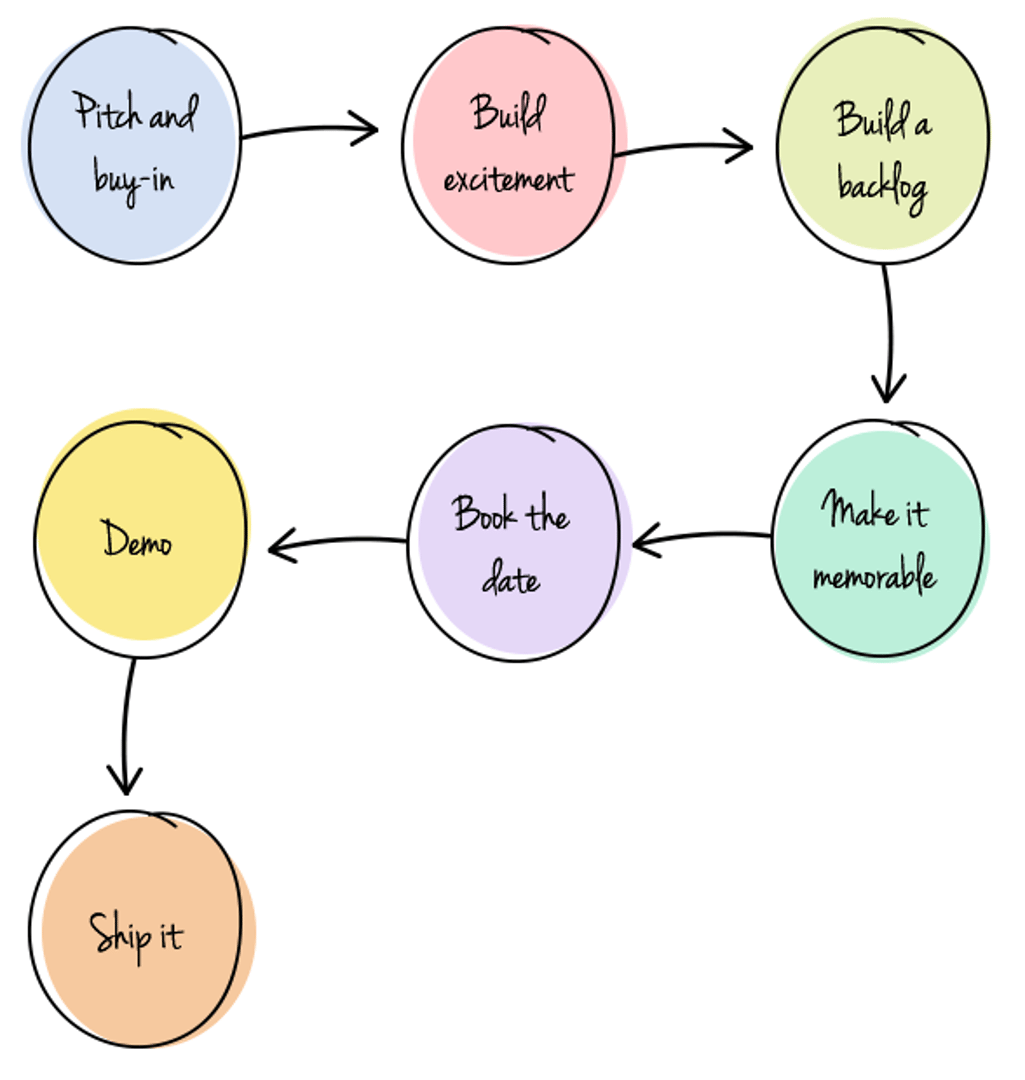
Step 1: Pitch your hackathon and win buy-in
Your first task is securing approval from leadership. Even though hackathons are common in tech, some organizations hesitate to release developers from regular work. Anticipate objections and address them head-on in a pitch deck.

Include these key points:
- What's a hackathon? A brief definition and overview of formats (one-day, multi-day, themed, open-ended).
- Real-world examples. Reference companies that run hackathons: Netflix, Google, IBM, Shopify, and others. Include startups and established firms to show it works across company sizes.
- Proven outcomes. Highlight products born from hackathons or free-time projects: Gmail, LinkedIn's "Year in Review," Slack features, and Shopify innovations. These examples prove hackathons generate real value.
- Developer benefits. Autonomy, skill development, and recognition motivate teams. Tie this back to retention and engagement.
- Business benefits. Motivated teams drive innovation, reduce churn, and generate ideas worth pursuing. Frame hackathons as a low-risk way to invest in culture and future capabilities.
- Your proposal. Include duration, scope, frequency, and success metrics. Show you've thought through logistics.
Once you secure buy-in, the hardest part is behind you. Now build momentum with your team.
Step 2: Build excitement for your hackathon
Approval from leadership means nothing if your team isn't energized. Make the hackathon impossible to ignore.

Try these tactics:
- Present to the team. Share a developer-focused version of your pitch deck. Highlight personal benefits: learning, autonomy, and visibility.
- Show your enthusiasm. Your energy is contagious. Talk about the hackathon unprompted. Celebrate the fact that leadership backed it. Make it clear this matters to you.
- Brainstorm together. Run a group ideation session. Encourage wild ideas. Write them down in real time so people see their input valued.
- One-on-ones. Ask individuals what they'd like to work on. Listen. Validate their ideas. This personal touch drives commitment.
- Casual conversations. Mention the hackathon in hallway chats, Slack messages, and team meetings. Repetition builds anticipation.
Use every channel to reinforce that this event is important, achievable, and designed for your team's benefit.
Step 3: Build a backlog before your hackathon
The day of your hackathon, you don't want developers wasting time deciding what to build. Create a shared document (wiki, Google Doc, Slack channel, or project board) at least one week before the event and start collecting ideas.

Invite suggestions from:
- Your development team. They know what's broken, slow, or missing.
- Product and design. They see user pain points and feature gaps.
- Support and operations. They hear customer feedback and know what causes friction.
Make it explicit: developers are free to choose any idea—or invent their own. The backlog is a starting point, not a constraint. This respects autonomy while reducing decision fatigue on event day.
A solid backlog saves time, provides structure, and ensures everyone has something to work on, even if they struggle to come up with ideas on the spot.
Step 4: Make your hackathon different and memorable
Hackathons should feel distinct from regular work. Create separation through environment and experience.

Consider these approaches:
- Special food and refreshments. If your office already provides free snacks, go beyond the usual. Budget for catered meals, specialty coffee, or treats. This signals the day is special.
- Change the venue. If possible, move to an off-site location: a coffee shop, co-working space, or nearby hotel conference room. Even a modest venue change shifts the mindset.
- Visual markers. Print posters, rearrange desks into team clusters, or decorate the workspace. Small touches reinforce the occasion.
- Dedicated communication. Create a Slack channel, Discord server, or Teams channel for real-time updates, questions, and celebration.
- Music and energy. Play background music. Keep energy high with check-ins and shout-outs throughout the day.
The goal is to make developers feel like they're part of something bigger than their daily routine.
Step 5: Book the date and prepare logistics
Timing is critical. You need a window when developers can focus without competing deadlines.

Here's how to protect the day:
- Avoid crunch periods. Don't schedule during a critical product launch, major deadline, or customer emergency. You'll never find a "perfect" time, but avoid the worst possible windows.
- Block calendars. Reserve everyone's time weeks in advance. Cancel or reschedule routine meetings so developers aren't pulled away.
- Communicate externally. Notify product managers, designers, and other stakeholders that your team is unavailable. Set expectations so no one is surprised.
- Final reminder. The day before the event, gather the team briefly. Reiterate excitement, confirm project choices, and answer last-minute questions.
One small caveat: while you shouldn't dictate what people build, quietly encourage at least one project polished enough to demo to leadership. This demonstrates ROI and justifies future hackathons.
Step 6: Host a demo and celebration
The demo is where hackathons prove their worth. It's the moment developers show what they built and celebrate together.

Make the demo event count:
- Invite leadership and stakeholders. Ensure senior management, product leads, and other teams attend. Visibility matters.
- Give teams adequate time. Each team should have 5–10 minutes to pitch and demo. Rushing undermines the effort.
- Consider recognition. Depending on your culture, you can award winners (voted by judges or audience), give monetary prizes, or hand out trophies. Some organizations skip winners to avoid discouraging non-winners, but a little friendly competition often energizes people.
- Celebrate effort, not just outcomes. Recognize teams that tackled ambitious ideas, even if they didn't finish. Effort and learning matter as much as polish.
The demo transforms abstract work into visible, shareable achievement. It's the payoff moment.
Step 7: Ship it
Here's the truth: if hackathon projects never make it into production, developers lose motivation. They'll see the next hackathon as a fun distraction, not a path to impact.

Your job as a manager is to shepherd at least one project into your product roadmap. This doesn't mean shipping every hack—be selective. But committing to productize a solid idea sends a powerful signal: hackathons generate real value, and your team's creativity shapes the product.
When developers see their hack live, they feel ownership and pride. They'll approach the next hackathon with even more energy.
Wrapping up
Hackathons are one of the most effective tools a development manager has to build engagement, unlock creativity, and strengthen culture. By following these seven steps—from securing buy-in to shipping results—you'll create an event your team anticipates and remembers.
The payoff is worth the effort: motivated developers, fresh ideas, and a stronger product roadmap.
Also see:
How do dashboards help agile software development teams?
Build a knowledge-sharing culture with Lightning talks in six easy steps
Related Articles

Anatomy of a great API
By Danielle Hodgson — January 21st, 2026
Klipfolio Partner How-To #1: Duplicating dashboards across client accounts
By Stef Reid — November 27th, 2025
Klipfolio Partner How-To #2: Company Properties can simplify client set-up
By Stef Reid — November 26th, 2025