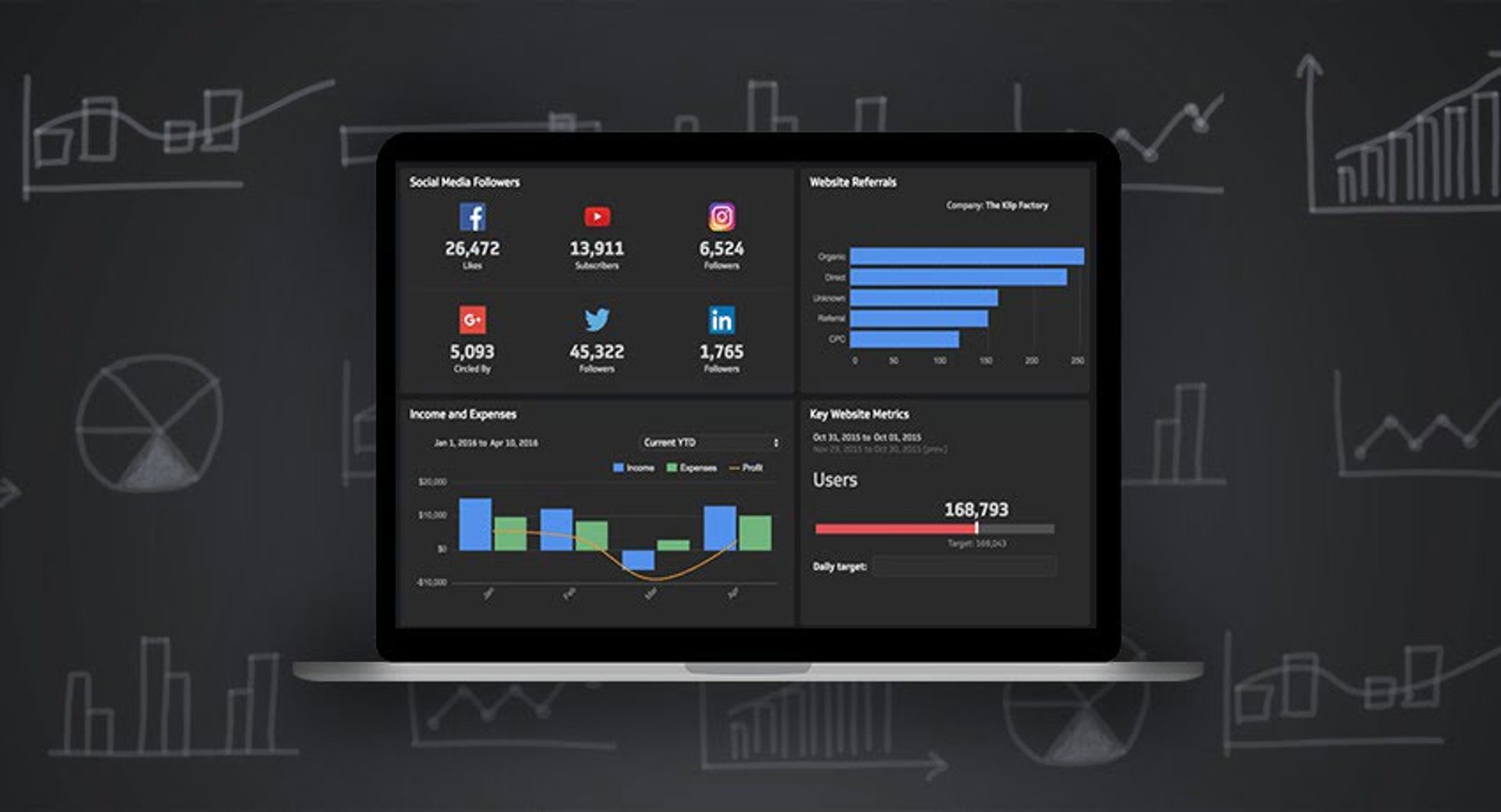

Summary - SaaS metrics are the numbers that tell you whether your business is growing, holding steady, or heading for trouble. This cheat sheet covers the 10 most important SaaS metrics every founder, finance leader, and team manager should know, including Monthly Recurring Revenue, Churn, Customer Acquisition Cost, and more.
SaaS metrics are the numbers that tell you whether your business is growing, holding steady, or heading for trouble. This cheat sheet covers the 10 most important SaaS metrics every founder, finance leader, and team manager should know.
You won't need to dig through a report or wait for someone to pull a number. Each metric below includes a plain-language definition, a formula, and the decision it supports. Add them to a Klips dashboard and you'll know where your business stands without having to ask.
Metrics covered in this article:
- Monthly Recurring Revenue
- Annual Recurring Revenue
- Churn
- Customer Retention Rate
- Sales Cycle Length
- Weighted Annual Contract Value (ACV)
- Customer Acquisition Cost (CAC)
- Customer Lifetime Value (LTV)
- Net Promoter Score (NPS)
- Product Qualified Leads (PQLs)
SaaS revenue metrics
Revenue metrics tell you whether your business is healthy. They surface growth, flag early warning signs, and give you something concrete to act on before a problem compounds.
When you look at your revenue numbers, you're not just checking a figure. You're asking: Is this business growing? Where is money leaking? What needs attention this month? That's the right frame for every metric in this section.
1. Monthly Recurring Revenue
What it is: Monthly Recurring Revenue (MRR) is the total subscription revenue your business collects each month, normalized to a single number.
MRR is your clearest signal of business momentum. Segment it into new business, expansion, contraction, and churn, and you'll know exactly where growth is coming from and where it's slipping.
Calculate it:
ƒ Sum(Recurring subscription charges normalized to a monthly amount; exclude one-time fees)
2. Annual Recurring Revenue
What it is: Annual Recurring Revenue (ARR) is the yearly value of your subscription revenue.
ARR gives you the bigger picture. Where MRR shows you what's happening month to month, ARR tells you the scale of the business and anchors your growth forecasts. Investors and leadership teams rely on it to set direction.
Calculate it:
ƒ 12 × MRR (at period end)
3. Churn
What it is: Churn measures the percentage of customers who cancel their subscription in a given period.
Every churned customer is a direct hit to MRR. Acquiring a new customer almost always costs more than keeping one, so churn is worth watching across every team, not just customer success. A spike in churn is a signal to dig deeper: Is there a product issue? Are support tickets trending up? The number points you toward the question.
Calculate it:
ƒ Count(Churned Customers in Period) / Count(Customers at Start of Period)
SaaS sales and support metrics
Sales brings in new revenue. Support keeps it. Together, these metrics tell you how efficiently your business converts and retains customers.
4. Customer Retention Rate
What it is: Customer Retention Rate measures the percentage of customers your business keeps over a given period.
Retention has a direct line to revenue. Every customer you keep is one you don't have to replace. High retention creates room for expansion and renewals. Slipping retention is an early warning that something in the experience is breaking down.
Calculate it:
ƒ (Count(Customers End of Period) - Count(New Customers in Period)) / Count(Customers Beginning of Period)
5. Sales Cycle Length
What it is: Sales cycle length is the average number of days it takes to close a deal, from first touch to signed contract.
A shorter cycle means faster revenue. A longer one raises questions about qualification, process, or fit. Use this metric when building a sales forecast, measuring team efficiency, or preparing for investor conversations.
Calculate it:
ƒ Sum(Days from First Touch to Close for Closed-Won Deals) / Count(Closed-Won Deals)
6. Weighted Annual Contract Value (ACV)
What it is: Weighted ACV expresses average contract value across customer segments, adjusted for the proportion each segment represents.
A simple ACV average can mislead you when a few very large or very small contracts dominate the mix. Weighted ACV corrects for that, giving you a more reliable number for pricing decisions, forecasting, and segment-level strategy.
Calculate it (by segment share):
ƒ (ACV SMB × % SMB Customers) + (ACV Mid-Market × % Mid-Market Customers) + (ACV Enterprise × % Enterprise Customers)
SaaS marketing and growth metrics
Marketing drives the top of your funnel. These metrics tell you whether that spend is turning into revenue, and which segments are worth doubling down on.
7. Customer Acquisition Cost (CAC)
What it is: Customer Acquisition Cost (CAC) is the fully loaded cost of acquiring a single new customer, including sales and marketing spend.
CAC answers a question every leader needs to know: how much does it actually cost to bring in a customer? Measure it by segment, territory, or channel to find where you're efficient and where you're overspending. Paired with LTV, it tells you whether the economics of your business hold up.
Calculate it:
ƒ Sum(Sales Costs + Marketing Costs) / Count(New Customers)
8. Customer Lifetime Value (LTV)
What it is: Customer Lifetime Value (LTV) is the total revenue your business can expect from a single customer account over the full relationship.
LTV tells you which segments are worth the most over time, not just at the point of acquisition. Finance and marketing teams use it to set payback thresholds, prioritize segments, and stress-test growth assumptions. A healthy LTV-to-CAC ratio is one of the clearest signs a SaaS business is built to scale.
Calculate it:
ƒ (Average Revenue per Account) × (1 / Logo Churn Rate) × (Gross Margin %)
9. Net Promoter Score (NPS)
What it is: Net Promoter Score (NPS) measures how likely customers are to recommend your product to someone they know.
Word-of-mouth is one of the most cost-effective growth channels in SaaS. NPS separates your promoters from your detractors so you know where to invest in customer experience and where to intervene before a detractor becomes a churned account.
Calculate it:
ƒ (% Promoters) - (% Detractors)
10. Product Qualified Leads (PQLs)
What it is: Product Qualified Leads (PQLs) are potential customers who have demonstrated high purchase intent through their in-product behaviour.
PQLs cut through the noise of page visits and form fills. Because they're based on actual product usage, they tend to convert at higher rates than marketing qualified leads (MQLs) or sales qualified leads (SQLs). Tracking PQLs helps your sales team focus on the leads most likely to close.
Calculate it:
ƒ Count(PQLs)
Bonus SaaS metrics worth tracking
The 10 metrics above cover your core funnel. These four go deeper on retention, growth efficiency, and product engagement. Add them to your dashboard when you're ready to move beyond the basics.
- DAU/MAU Ratio: The ratio of daily active users to monthly active users. A reliable signal of how sticky your product actually is.
- Expansion MRR Growth Rate: How fast revenue from existing customers is growing through upgrades and add-ons.
- Net Revenue Retention Rate: The percentage of revenue retained from existing customers after churn, contraction, and expansion. A rate above 100% means your existing base is growing even without new customers.
- Time to Value: How long it takes a new customer to reach their first meaningful outcome. Shorter time to value typically means lower early churn.
Related Articles

5 tips to understand (and organize) your restaurant data
By Saleem Khatri — June 9th, 2026
6 dashboards I use daily to run my SaaS company
By Allan Wille, Co-Founder — April 10th, 2026
Business Metrics vs. KPIs: What’s the Difference?
By Jonathan Taylor — March 13th, 2026