Recent Payments Metric
Always know where your money is coming from by tracking your recent payment history
Track all your Financial KPIs in one place
Sign up for free and start making decisions for your business with confidence.
What is Recent Payments?
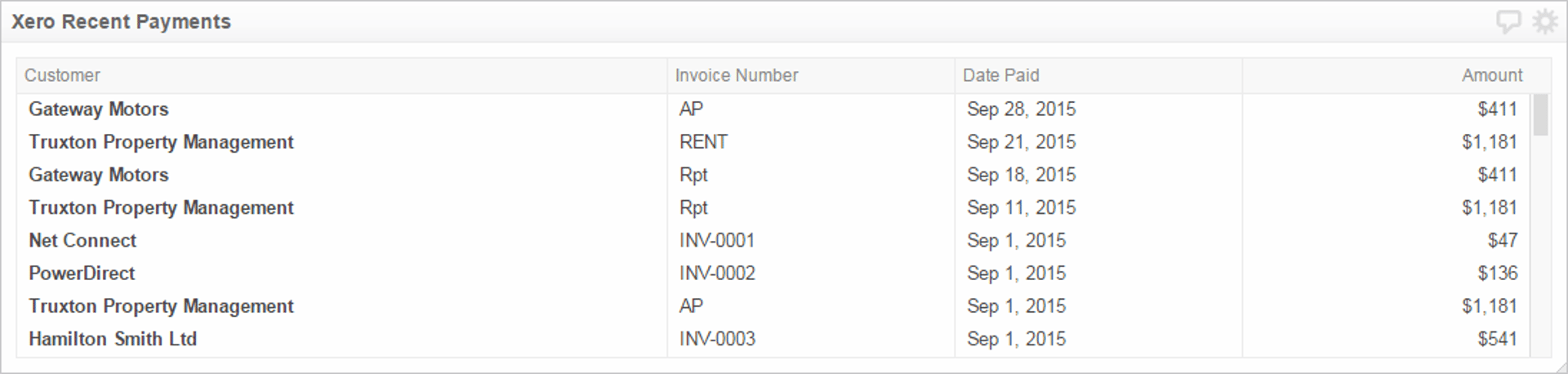
Recent Payments shows the most recent cash receipts recorded in your accounting system, who paid, and how much each customer paid. Think of it as a live feed of money coming in. The metric helps finance teams see whether inflows are keeping pace with plan, which accounts are active this week, and whether any large expected payments have not landed yet.
Why Recent Payments matter
- Cash clarity: A rolling view of receipts helps you manage daily cash needs without waiting for end-of-month reports.
- Collections control: You can confirm that promised payments arrived and follow up quickly when they do not.
- Forecast accuracy: Comparing actual receipts to your forecast improves your short-term cash projections.
- Risk spotting: Concentration in a handful of payers or an unusual lull can flag credit risk or delivery issues.
- Executive visibility: A clear dashboard tile cuts back-and-forth emails asking what came in today.
Recent Payments are tactical. They connect the revenue you book to the cash that hits the bank, which is where confidence comes from.
How to structure and calculate Recent Payments
Unlike ratios, this KPI is a list that rolls forward each day. Still, you can apply simple calculations to turn a list into insight:
- Total Cash Collected (period): Sum of payment amounts received in the selected period.
- Number of Payments (period): Count of distinct payments in the period.
- Average Payment Size: Total Cash Collected / Number of Payments.
- Median Payment Size: Middle value when you sort payments by amount, helpful when a few large payments skew the average.
- Payment Method Mix: Share by card, ACH, wire, cheque, or cash. Mix changes can impact fees and posting time.
- Customer Concentration: Percentage of period receipts from the top 5 customers.
Define the period windows you care about, for example today, last 7 days, month to date, and last 30 days. Keep the definitions consistent so leaders can scan trends without decoding filters each time.
Data definitions
- Payment date: The date the payment is recorded in your accounting system. Decide whether you use bank settlement date or invoice application date and document the rule.
- Payment amount: Gross amount received. Track fees separately so you can reconcile to bank deposits.
- Customer: The account name on the invoice. Standardise names to avoid duplicates that hide true concentration.
- Applied to: The invoice or group of invoices cleared by the payment. This helps with dispute tracking and revenue assurance.
Example calculation
Over the last 7 days, your team posted 42 payments with a total of $128,600. The largest five payments total $77,000. Card fees on card payments were $1,420.
- Number of Payments: 42
- Total Cash Collected: $128,600
- Average Payment Size: $128,600 / 42 = $3,062
- Median Payment Size: $1,950
- Top 5 Concentration: $77,000 / $128,600 = 59.9 percent
- Estimated Card Fees: $1,420 (track separately so finance can reconcile to net bank deposits)
This snapshot shows healthy activity, yet a high concentration. That tells your team to follow up on a broader set of open invoices to reduce risk next week.
What is a good benchmark?
Benchmarks depend on your billing model, invoice size, and payment terms. Use policy targets rather than rigid industry numbers for this KPI:
- Posting timeliness: 95 percent of payments posted within one business day of receipt.
- On-time rate: 85 to 95 percent of receipts arrive by invoice due date when terms are Net 30 and reminders are active.
- Concentration risk: Top 5 customers contribute less than 50 percent of receipts in a 30-day window.
- Payment method shift: Move at least 60 percent of receipts to ACH or other low-fee methods to reduce costs and speed settlement.
Pair Recent Payments with ageing and DSO to set targets that reflect both speed and quality of collections.
How to improve Recent Payments
- Invoice cleanly: Send invoices with accurate PO references, clear line items, and correct tax. Clean invoices get paid faster.
- Offer low-friction methods: Provide ACH instructions and secure links on invoices. Fewer cheques mean fewer delays.
- Send smart reminders: Trigger friendly reminders 7 days before due date, on due date, and 7 days after. Vary the copy for first-time and repeat late payers.
- Resolve disputes fast: Tag payments that arrive short and link them to credit notes. Close the loop with sales or customer success so root causes do not repeat.
- Prioritise collections work: Focus follow-ups on the largest upcoming invoices and those with a history of lateness.
- Reconcile daily: Match bank deposits to posted payments so your dashboard reflects reality, not just expectations.
How to monitor Recent Payments in Klips
Klips helps you centralise receipts from your accounting and payment systems, calculate simple rollups, and share a live view with finance and leadership.
- Connect data sources: Pull payments from your accounting tool and payment processor exports or APIs. Include payment date, amount, customer, method, currency, and applied invoice.
- Standardise fields: Normalise customer names and payment methods. Keep a currency field and a reporting currency for conversion.
- Build measures: Create Total Cash Collected, Number of Payments, Average and Median Payment Size, and Top 5 Concentration. Add filters for date range, customer segment, and method.
- Visualise for clarity: Use a single value for today’s cash, a 13-month line for trend, and a table of the last 20 payments with customer, amount, method, and invoice link.
- Flag exceptions: Highlight short pays, unapplied cash, or large expected payments not yet received.
- Distribute with control: Schedule daily PDFs for finance, show a wallboard in the office, and share secure links for executives. Everyone sees the same numbers.
For a complete cash picture, pair this KPI with Current Accounts Receivable and Accounts Payable and Cash and Cash Equivalents. Those tiles show what is still owed and what sits in the bank today.
Reporting frequency
Daily is best for operations. Keep a weekly and monthly rollup for board packs and lender reporting. During peak billing cycles, add an intraday view so teams can spot gaps before the bank cut-off.
Similar KPIs